How to Choose the Best Solar Pumps for Your Needs?
Choosing the right Solar Pumps begins with the water requirement, not the panel size. A remote farm, household, or livestock station may need different equipment. Measure the daily water volume, total lifting height, pipe distance, and seasonal sunlight. A pump that looks powerful may still underperform when wells fall or clouds persist.
Dr. Thomas Reindl, a recognized solar-energy specialist, offers a useful principle: “Good solar design begins with the demand, not the panel.” This idea matters when comparing submersible, surface, and hybrid Solar Pumps. Check the pump’s flow rate at the actual head height. Do not rely only on the advertised maximum output. That number can mislead.
Think about the water source.
A narrow borewell may require a slim submersible pump. A shallow pond may suit a surface model with easier maintenance access. Direct solar systems can reduce battery costs, but water storage may be more practical than electrical storage. A raised tank, for example, can hold afternoon pumping for evening use.
Real conditions often challenge neat calculations. Dust can cover panels. Dry seasons can change demand. A system may need protection from sand, voltage fluctuations, or accidental dry running. I have seen specifications appear convincing until pipe friction was included. That detail is easy to miss.
The best choice balances output, reliability, installation skill, warranty support, and long-term operating costs. Compare performance charts carefully. Ask for service records and replacement-part availability. If your calculations feel uncertain, pause and obtain an independent assessment. A slightly smaller, well-matched system may serve better than an oversized pump that wastes energy and money.
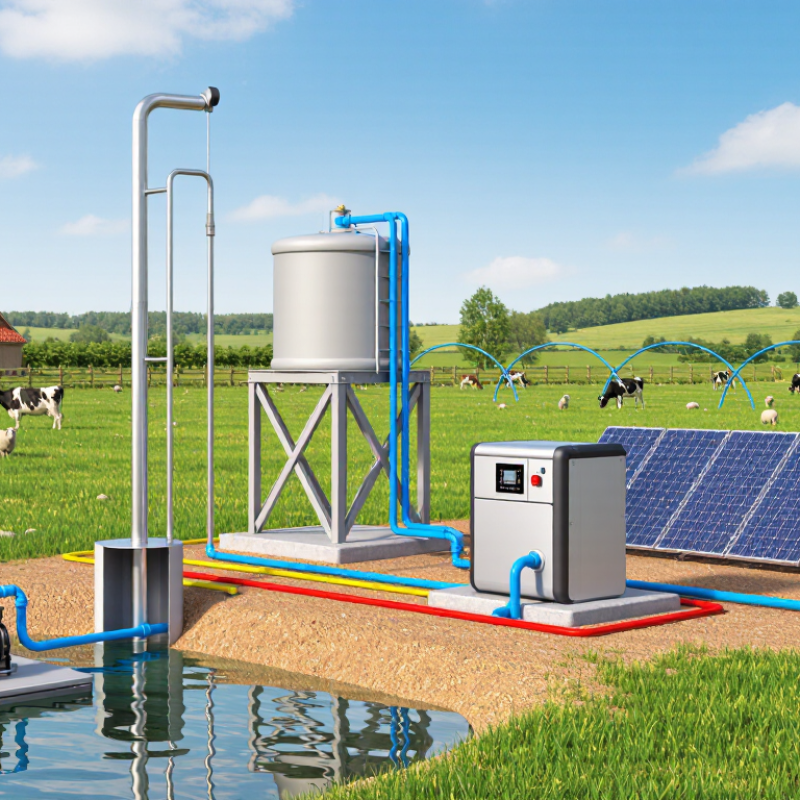
Define Daily Water Demand, Total Dynamic Head, and 4–6 Peak-Sun-Hour Conditions
How to Choose the Best Solar Pumps for Your Needs?
Begin with daily water demand, not pump horsepower. Estimate drinking water, livestock, cleaning, and irrigation separately. The World Health Organization reports that basic domestic needs generally require 20–50 liters per person daily. Irrigation can exceed household demand by many times. Measure actual flow for several days when possible. A neat spreadsheet can still be wrong.
Next, calculate Total Dynamic Head (TDH). Add the vertical lift, pipe friction, fittings, storage-tank height, and required outlet pressure. A 30-meter well does not always mean a 30-meter head. Narrow pipes and long runs may add significant losses. Use pipe charts or engineering software, then verify the result in the field. Small errors here can reduce delivered water sharply.
Solar output changes hourly and seasonally. The World Bank’s Global Solar Atlas uses long-term satellite data to estimate local solar resources. Many designs assume 4–6 peak-sun hours daily, but this range is not universal. Check the weakest sunny-season month, not only the annual average. Size the pump around required liters per day, TDH, and available solar energy. NREL’s PV performance guidance also shows that heat, dust, wiring losses, and conversion limits reduce real output. Leave practical margin. Oversizing panels may cost less than repeated water shortages, yet excessive capacity wastes money and materials. Review the design after observing one full season.
How to Choose the Best Solar Pumps for Your Needs? — Define Daily Water Demand, Total Dynamic Head, and 4–6 Peak-Sun-Hour Conditions
| Application Profile | Daily Water Demand (L/day) |
Total Dynamic Head (m) |
Peak Sun Hours (h/day) |
Target Flow Rate (L/min) |
Estimated Pump Motor (W) |
Recommended PV Array (W) |
Typical Use |
|---|---|---|---|---|---|---|---|
| Small household supply | 1,500 | 25 | 4–6 | 6–8 | 250–350 | 400–550 | Drinking water, cooking, washing, and basic sanitation for approximately 3–5 people. |
| Large household supply | 3,000 | 35 | 4–6 | 10–14 | 500–700 | 800–1,100 | Household water supply with outdoor cleaning, limited livestock, or a small garden. |
| Small livestock watering | 5,000 | 40 | 4–6 | 14–20 | 800–1,100 | 1,300–1,700 | Watering cattle, goats, sheep, or other livestock where a storage tank is available. |
| Small drip-irrigation plot | 10,000 | 30 | 4–6 | 25–35 | 900–1,300 | 1,500–2,000 | Vegetable or fruit production using drip lines and a daily water-storage tank. |
| Medium irrigation field | 25,000 | 50 | 4–6 | 45–60 | 2,000–2,800 | 3,200–4,500 | Higher-volume crop irrigation with filtration, pressure regulation, and water storage. |
| Deep-well community supply | 50,000 | 80 | 4–6 | 70–90 | 4,000–5,500 | 6,500–8,500 | Shared water supply from a deep borehole, normally pumping into an elevated storage tank. |
- Daily water demand should include household use, livestock, irrigation, cleaning, and a practical reserve of approximately 10–20%.
- Total Dynamic Head includes the vertical lift, water-level variation, pipe friction, fittings, filters, valves, and the required outlet pressure.
- Peak sun hours are equivalent hours of sunlight at approximately 1,000 W/m². A design range of 4–6 hours/day is commonly used for preliminary solar-pump sizing, but the site’s monthly solar resource should be checked.
- The recommended PV array includes allowance for pump, controller, temperature, wiring, dust, and solar-output losses. Final selection should use the pump manufacturer’s flow-versus-head performance curve.
- Estimated motor values assume approximately 45–60% overall wire-to-water efficiency and are indicative sizing ranges, not a substitute for field verification.
Match Pump Type to 20–40% Typical Solar-System Efficiency
A solar pump should match real water demand, not only panel wattage. Solar systems often deliver just 20–40% of their rated output during practical operating conditions. Clouds, heat, dust, wiring losses, and controller limits reduce available power. This range is a planning guide, not a universal efficiency rating.
A shallow well may suit a surface centrifugal pump. A deep borehole usually needs a submersible pump.
Diaphragm pumps can work for lower flows, but they may require more maintenance.
Measure the total dynamic head before choosing a model. Include lifting height, pipe friction, storage-tank height, and required pressure. Then compare the pump’s flow curve with your daily water target.
A pump that moves water quickly may stop during weak sunlight. A smaller pump can run longer and use energy more steadily. That trade-off is easy to overlook.
In practice, many designs also need extra panel capacity, especially when direct solar pumping has no battery backup. However, oversizing panels without checking controller limits can create another problem.
Record sunlight conditions for several days, not just one bright afternoon. Check water output at morning, noon, and late afternoon. Keep pipes short and properly sized. Use a float switch to prevent dry running. Recheck your calculations after installation; real soil depth, seasonal water levels, and dust may differ from the original estimate.
Size PV Capacity with Q × H × 9.81 and a 25% Energy Reserve
Choosing a solar pump starts with water duty, not panel count. Measure flow rate Q in cubic metres per second and total head H in metres. Then calculate hydraulic power with Q × H × 9.81, producing watts before efficiency losses. A pump moving 0.002 m³/s through 30 metres needs about 589 watts hydraulically. Real systems need more.
Allow for pump, motor, controller, cable, and temperature losses. If combined efficiency is 55%, that example requires roughly 1.07 kW electrically. Add a 25% energy reserve for cloudy hours, dust, ageing, and imperfect field conditions. The practical target becomes about 1.34 kW, before checking daily sunlight and operating hours. Keep this distinction clear: reserve applies to energy demand, not only nominal panel power.
The IEA PVPS Trends 2024 report recorded about 447 GW of new solar capacity worldwide in 2023, showing rapid deployment but not guaranteed site performance. Local irradiance still matters. NREL’s PVWatts documentation also highlights losses from temperature, wiring, and system components. Use measured well levels and seasonal flow requirements where possible. Small errors matter.
A 25% reserve is useful, not sacred. In dusty areas or during monsoon months, it may be too small. I would test the design against the weakest solar month, then compare predicted flow with a field measurement. The calculation is simple. The assumptions are not.
Verify IEC 61215/61730 Panels, IP65+ Enclosures, and MPPT Controllers
Choosing the best solar pump begins with checking the complete power system, not only the pump. For outdoor installations, verify that panels meet IEC 61215 and IEC 61730 requirements. IEC 61215 addresses performance and durability testing, while IEC 61730 focuses on electrical safety. Request current certificates and test records, because printed claims can become outdated. An IP65 or higher enclosure protects against dust and water jets. It does not guarantee safe submersion. Place controllers above splash zones, with cable glands tightened against rain and insects. An MPPT controller can harvest more energy as sunlight changes during the day. However, it must match the panel voltage, pump current, and battery configuration.
Tips: Compare the controller’s cold-start voltage with your local morning conditions. Ask for surge protection and thermal shutdown details. In dusty fields, inspect seals every few months. Keep photos of serial labels and certificates for future maintenance. These small records help when performance drops unexpectedly.
From practical installation checks, cable length often causes more trouble than expected. Thin cables create voltage loss, especially between a remote array and a deep well. Size conductors using the actual distance, current, and local temperature. Pump sizing also deserves honest review. A larger pump may waste energy if the well recovers slowly. I have seen systems pass a basic test, then underperform during cloudy weeks. That experience is a reminder to test flow at different times, not just at noon. If specifications remain unclear, ask for measured flow, head, and efficiency data. Do not rely on a single laboratory number.
Compare Lifecycle Cost, 5–10-Year Maintenance Needs, and Warranty Terms
How to Choose the Best Solar Pumps for Your Needs?
A low purchase price can hide expensive maintenance. Compare the full lifecycle cost, including panels, mounting, controller, wiring, storage, labor, and pump replacement. Record your required water volume, lifting height, and seasonal sunlight before comparing quotations. A pump moving 20,000 liters daily may cost more initially but reduce energy and replacement expenses over ten years.
Maintenance needs usually change after installation. During years one to five, inspect cable connections, dry-run protection, filters, and pipe leaks every three to six months. Clean panels when dust reduces output.
By years six to ten, worn seals, bearings, sensors, and batteries may require closer attention. Battery systems often need replacement earlier than the pump itself. Keep a simple maintenance log. It reveals patterns that memory misses.
Warranty terms deserve careful reading. Check coverage length, guaranteed performance, repair response time, and whether labor, shipping, or site visits are included. Some warranties cover manufacturing defects but exclude dry running, sand damage, lightning, poor installation, or unauthorized repairs. Ask whether coverage declines over time.
A five-year warranty is not automatically stronger than a three-year warranty with clearer service obligations.
I would also request written testing procedures and spare-parts availability.
A mistake I have seen is comparing warranty years without comparing exclusions. That comparison is incomplete.
Related Posts
-
How to Choose the Best Solar Well Pump for Your Water Needs
-

Exploring the Surge of Solar Pumps Demand at the 137th Canton Fair: Insights and Opportunities
-
Unleashing the Potential of Solar Powered Pumps at the Record Breaking 137th Canton Fair
-
Global Leadership in Solar Solutions Best Solar Powered Pumps from China
-
Top Solar Water Pumps for Global Buyers in 2026?
-
Exploring Versatile Applications of Best Solar Panel Water Pumps and Effective Usage Tips
Contact Details
Address:
Solar Pump Solutions,
Borrisokane, Co. Tipperary, Ireland.
