
2026 Top Quartz Sink Types for Global Buyers
Global buyers will face more quartz sink choices in 2026 than ever before. Single-bowl, double-bowl, workstation, undermount, and top-mount models now serve different kitchen habits. Each type combines crushed quartz, resin, and carefully engineered surfaces. The result can feel like stone, but performance still depends on manufacturing quality.
Quartz-surface consultant Elena Marlow observes, “A beautiful sink fails when its daily workflow was never tested.” That principle guides this overview. We examine bowl depth, drain placement, rim design, scratch resistance, heat tolerance, and installation requirements. These details matter during customs handling and final fitting. They also affect long-term maintenance in homes, hotels, and commercial kitchens.
Materials are not identical. Neither are buyer priorities. A deep single bowl may suit large cookware, while a divided model supports simultaneous food preparation. Workstation designs add useful accessories, but they can require more counter space. Dark finishes look dramatic, although water marks may appear sooner. Light finishes can feel cleaner, yet stains still require prompt care.
No ranking is perfect. quartz sink performance can change with resin ratios, curing methods, and local water conditions. Global buyers should request technical sheets, warranty terms, test results, and replacement availability. They should also confirm cabinet dimensions before ordering. This guide compares leading quartz sink types with practical, market-aware judgment. It highlights strengths, limitations, and overlooked installation risks. The goal is not to promote one universal winner. It is to help importers, designers, distributors, and homeowners choose with fewer surprises.
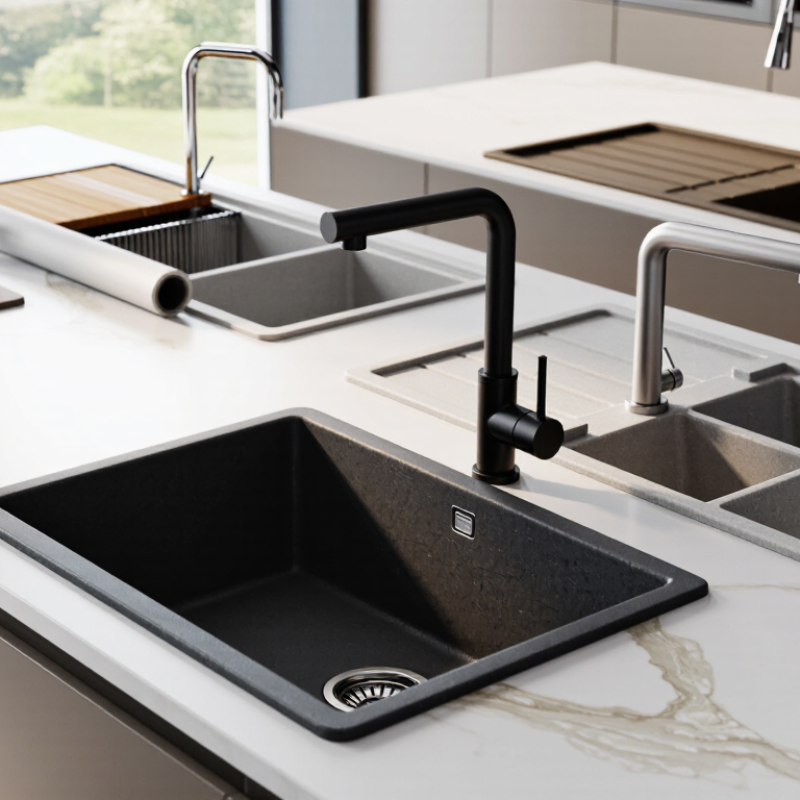
What Quartz Sinks Are and Why They Matter in 2026
In 2026, quartz sinks are engineered composite basins, not blocks of pure quartz. Manufacturers blend natural quartz particles with resin and pigments. This structure creates a dense, heavy surface with consistent color and a stone-like feel. It matters because buyers are choosing performance, not only appearance. A dark sink can anchor a bright kitchen. A pale basin can reveal residue faster. Small details affect daily use.
Common options include single-bowl, double-bowl, top-mount, undermount, and workstation designs. Single bowls suit large cookware. Double bowls separate washing from rinsing. Top-mount models simplify replacement, while undermount edges create a cleaner counter line. Workstation sinks add ledges for boards or colanders. The feature sounds useful. Measure carefully.
For global buyers, value depends on tested specifications and local installation conditions. Request composition details, bowl dimensions, drain size, weight, heat guidance, and stain-resistance data. Confirm cabinet clearance before ordering. Quartz composite can handle everyday scratches, impact, and heat, but it is not indestructible. Sudden thermal changes, abrasive powders, and falling cookware may damage the surface. Inspect the underside, drain area, and overflow finish. These overlooked zones often reveal manufacturing consistency. Color and texture can vary between production batches. A digital sample cannot show that clearly.
| Quartz Sink Type | What It Is | Typical Configuration | Common Size Range | Main Advantages | Important Considerations | Best-Fit Applications | 2026 Buyer Relevance |
|---|---|---|---|---|---|---|---|
| Single-Bowl Quartz Sink | A deep, continuous basin made from engineered quartz composite, generally consisting of mineral aggregate bound with resin. | One large bowl; commonly available in undermount, top-mount, or flush-mount installation formats. | Approximately 600–900 mm wide; bowl depth commonly 200–230 mm. | Large uninterrupted washing area, simple appearance, and convenient cleaning of oversized cookware. | One basin provides less separation for washing and rinsing; deep bowls require adequate cabinet clearance. | Contemporary residential kitchens, rental housing, and compact commercial food-preparation areas. | High demand Strong fit for minimalist kitchens and large cookware. |
| Double-Bowl Quartz Sink | A quartz composite sink divided into two separate basins, usually with equal or unequal bowl sizes. | Typical ratios include 50/50, 60/40, and 70/30; available in several mounting styles. | Approximately 760–1,000 mm wide; bowl depth commonly 200–230 mm. | Allows simultaneous washing and rinsing, improved task separation, and flexible daily use. | Less space for large pans than a single bowl; the center divider can restrict oversized items. | Family kitchens, traditional kitchen layouts, and homes requiring separate washing zones. | Stable demand Useful where workflow separation is prioritized. |
| Low-Divide Quartz Sink | A double-bowl sink with a divider positioned below the rim, creating two zones while allowing large items to extend across the basins. | Usually 60/40 or 50/50 bowl distribution with a reduced-height center divider. | Approximately 760–900 mm wide; depth commonly 200–230 mm. | Combines two-bowl organization with better flexibility for baking trays, roasting pans, and stockpots. | The lower divider may provide less complete separation during filling or soaking tasks. | Modern family kitchens and buyers seeking a compromise between single- and double-bowl designs. | Growing interest Balances usability, capacity, and contemporary styling. |
| Workstation Quartz Sink | A quartz composite sink designed with integrated ledges that support accessories such as colanders, cutting boards, drying racks, or roll-up mats. | Usually one large basin; accessory systems vary by model and may be removable. | Approximately 760–1,000 mm wide; depth commonly 200–230 mm. | Creates additional preparation space, supports multifunctional workflows, and helps maximize limited countertop area. | Requires accurate accessory fit and sufficient clearance around the sink; ledges need regular cleaning. | Urban kitchens, compact layouts, open-plan homes, and multifunctional food-preparation spaces. | Fast-growing Matches demand for space efficiency and integrated kitchen functions. |
| Undermount Quartz Sink | A quartz composite sink installed beneath the countertop so the countertop edge remains visible and continuous around the basin. | Most often paired with stone, quartz, porcelain, or other solid-surface countertops. | Common widths range from approximately 500–900 mm, depending on bowl count and cabinet size. | Easy countertop wipe-down, clean visual lines, and a premium built-in appearance. | Needs a suitable countertop material, precise cutout, strong support, and professional installation. | High-end residential renovations, new-build kitchens, and seamless contemporary interiors. | Premium standard Frequently selected for clean aesthetics and easier surface maintenance. |
| Top-Mount Quartz Sink | A sink installed through a countertop opening with a visible rim resting on the countertop surface. | Available as single-bowl, double-bowl, and selected workstation configurations. | Common widths range from approximately 600–1,000 mm; dimensions depend on the cabinet and cutout. | Simpler installation, broad countertop compatibility, and easier replacement or retrofit potential. | The exposed rim can collect water or debris and does not provide the same seamless appearance as undermount installation. | Renovation projects, modular kitchens, rental properties, and cost-sensitive installations. | Broad market Practical for international projects with varied installation conditions. |
| Farmhouse-Front Quartz Sink | A forward-facing sink with an exposed front apron, produced from quartz composite for a substantial, textured, or stone-like appearance. | Commonly a deep single bowl; some designs use a low divide or paired basins. | Approximately 760–1,000 mm wide; depth commonly 200–250 mm. | High visual impact, generous capacity, and suitability for traditional, transitional, and modern farmhouse interiors. | Requires compatible base cabinetry, careful front-panel alignment, and attention to cabinet load support. | Large residential kitchens, lifestyle-led renovations, and heritage-inspired interiors. | Design-led niche Relevant where appearance and deep-basin capacity influence purchasing decisions. |
| Bar or Prep Quartz Sink | A compact quartz composite sink intended for secondary food preparation, beverage service, or entertainment areas. | Usually one small bowl; available in undermount or top-mount formats. | Approximately 350–600 mm wide; bowl depth commonly 150–220 mm. | Efficient use of limited space, durable surface, and coordinated appearance with the main kitchen. | Limited capacity for large cookware; installation should match the available plumbing and cabinet dimensions. | Kitchen islands, utility rooms, home bars, outdoor entertaining areas, and compact apartments. | Selective demand Supports secondary kitchen zones and flexible residential layouts. |
| Custom-Color or Textured Quartz Sink | A quartz composite sink offered in selected colors or surface textures beyond basic smooth neutral finishes. | May use single-bowl, double-bowl, workstation, undermount, or top-mount construction. | Available in both compact and full-size kitchen dimensions; specifications vary by design. | Supports coordinated interiors, hides minor water marks better in some finishes, and provides stronger design differentiation. | Color consistency, sample approval, cleaning instructions, and resistance to thermal shock should be verified before purchase. | Custom residential projects, hospitality interiors, and design-focused developments. | Design trend Responds to demand for personalization and coordinated interior palettes. |